Thanks to advances in dental materials, technology, and methods of care, it’s easier than ever before to replace missing teeth with the most natural-looking and aesthetically pleasing treatment outcomes. While dental implants and fixed bridgework provide effective and satisfying solutions for missing teeth, removable dentures remain a tried and true method for reestablishing a complete smile.
At the office of Stratford Family Dental, we fabricate dentures from the highest grade of dental materials for a precise and comfortable fit. Our dentures are meticulously designed to rebuild beautiful smiles and support natural facial contours while enabling patients to speak, smile, and chew with renewed confidence and ease.
We’re dedicated to helping patients to enjoy the benefits of a beautiful smile and take pride in offering personalized solutions to address their dental needs, lifestyle, and budget.
According to recent statistics, it’s estimated that across the country, over 175 million adults have lost at least one tooth, and close to 40 million are missing all of their teeth. In most of these cases, tooth loss is the end result of extensive dental decay, advanced gum disease, a traumatic injury, a congenital anomaly, or associated with a medical condition.
In addition to the psychological and social consequences having embarrassing gaps in your smile often produce, missing teeth can affect your ability to speak clearly and eat a satisfying and nutritious diet. Left unaddressed, missing teeth can also cause gradual changes to your appearance and the alignment of your remaining teeth. These changes not only affect your bite, but they have the potential to create more unsightly and unhealthy gaps in your smile. Furthermore, without the support of a complete set of teeth, facial contours may also begin to look more sagged and haggard over time.
While it’s never too late to rebuild a complete and beautiful smile, it’s always best to replace missing teeth sooner than later. Both partial and full dentures from the office of Stratford Family Dental offer an effective and satisfying solution for reestablishing a complete smile.

Dentures are removable appliances that are designed to precisely and comfortably rest on top of the gums that cover the jawbones. They consist of natural-looking artificial teeth set in a supportive base. In addition to offering a cost-effective solution for the replacement of missing teeth, dentures are quite versatile. They can be used to replace either a few teeth that have been lost or all of the teeth in the upper or lower jaws.
While conventional bridgework and dental implants offer fixed solutions for rebuilding complete smiles, partial and full dentures are removable oral appliances. This statement means it’s possible to take dentures out of the mouth to clean and maintain the health of the underlying tissues and any remaining teeth, as well as clean the dentures themselves, or remove them while sleeping.
You can rest assured that rebuilding your smile is in the best of hands at the office of Stratford Family Dental. As skilled and experienced providers of care, we’ll carefully evaluate all aspects of your smile, the health and integrity of any remaining teeth, along with the surrounding tissues and the supporting bone to develop a treatment plan that satisfies the functional and aesthetic requirements of your case.
The two main types of removable dentures are full dentures and partial dentures. Which of these types offers the best solution for your smile depends on how many natural teeth are still present in your mouth and the health of these remaining teeth. While a partial denture can offer an effective solution in cases where some sturdy natural teeth remain, you may be a candidate for a complete denture when all the upper or lower teeth are missing or require extraction.
Full dentures, also known as complete dentures, can effectively replace all the upper teeth, lower teeth, or both the upper and lower teeth. As with other types of dental solutions, there’s no one-size-fits-all approach for every case. The ultimate design, fabrication, and insertion of a full denture can vary based upon a patient’s specific needs.
This type of denture is fabricated and placed after all of the remaining teeth are removed, and the surrounding tissues have adequately healed. Fabricating a full denture when healing is complete supports a precise and comfortable fit.
Immediate Denture
With an immediate denture, a patient does not have to go without teeth while waiting for complete healing of the extraction sites. Although an immediate denture offers the advantage of not having to go without teeth for any length of time, it can require a reline and adjustments as the tissues remodel and heal. In some cases, for optimal comfort and fit, a conventional denture may eventually be required.
Overdenture
An overdenture is a type of complete denture that receives added stability and support from special attachments that are secured to the remaining underlying teeth or specialized dental implants.
Implant-Supported Dentures
As the name implies, this type of denture attaches to a select number of strategically placed implants in the upper or lower jaw. These small surgical posts provide precise points of attachment for the overlying denture and add a significant measure of stability and retention.
In situations where some sturdy teeth remain, partial dentures can offer an effective solution for the replacement of missing teeth. Partial dentures typically achieve adequate retention and stability with clasps or precision attachments on the teeth adjacent to the edentulous areas (the spaces formerly occupied by the missing teeth).
Removable partial dentures can fill the void left by individual missing teeth and multiple ones to restore the look and function of a complete smile. At the same time a partial denture fills the gaps left by missing teeth; it also stabilizes the dentition and bite and prevents unwanted drifting of the remaining natural teeth.
As with full dentures, partial denture design and fabrication varies based on a patient’s specific needs. With advances in dental materials and technology, partial denture wearers have more options than ever before. Today, a partial denture’s supportive framework can be fabricated from various materials, including cast metal, flexible resins, and hybrid materials.
At the office of Stratford Family Dental, we’re dedicated to building healthy and beautiful smiles. As your trusted partner in care, you can depend on our office to design and fabricate a denture that will look good, fit comfortably, and serve you well for years to come.
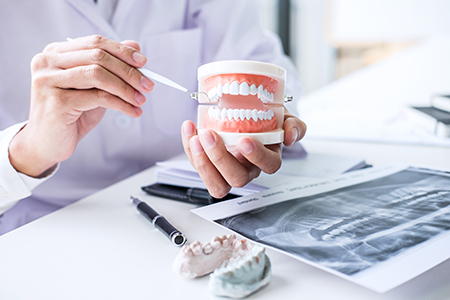
Fabricating an attractive, well-fitting, and long-lasting denture requires a comprehensive understanding of oral function, facial aesthetics, dental materials, and appliance design. At the office of Stratford Family Dental, we maintain a position at the forefront of advances in care and successfully combine the art and science of dentistry to provide patients with outstanding treatment outcomes.
Once we’ve had an opportunity to review your medical and dental history, assess all aspects of your smile, and discuss your expectation of care, we’ll discuss the best options for restoring and rebuilding your smile.
Based upon a comprehensive analysis of your case, including advanced diagnostic imaging, we’ll advise you if any dental work, additional procedures, or extractions are required prior to the fabrication of a partial or complete denture. It’s essential that any remaining teeth are healthy and have sufficient bone support. Sometimes, a pre-prosthetic procedure to improve the tissue anatomy and ensure a denture’s optimal fit is recommended.
Having a denture or set of dentures made is a sophisticated process involving dental impressions, framework try-ins, selecting the right shade, shape, and size of the artificial teeth, and making sure that the bite and all aspects of oral function are comfortable and healthy. Whether it takes a single visit or a few visits to fabricate a partial or complete denture, a satisfying and healthy outcome relies on the careful execution of every step in care.

At the office of Stratford Family Dental, our patients' care and comfort are our top priorities. Our goal is to help patients enjoy optimal oral health and to keep them well informed every step of the way.
Adjusting to wearing a new denture
Getting used to wearing a new denture, especially a full denture, can take a little time. It’s not unusual to need some minor adjustments as you begin to speak, chew, and function with your new teeth. It can take a few adjustments to fit completely and feel comfortable. If you have a sore spot, try to wear the denture at least the day before your adjustment visit. In this way, we can see exactly where we need to relieve the area causing your irritation.
More saliva than usual
One of the natural responses to a new denture is for your mouth to produce more saliva. Not to worry, this is only a temporary reaction. The flow of saliva gradually decreases back to a normal level.
Speaking with ease
While it may seem challenging to speak clearly at first with a new denture, that feeling will pass within a few days. It’s important to keep talking, as usual, to allow yourself to adapt to your new set of teeth. You can help things along by reading some passages from printed materials or a computer out loud.
Getting used to eating with a denture
If this is your first denture, it can also take some time to adapt to eating with your new prosthesis. Getting used to eating with a full denture is typically more challenging than doing so with a partial denture. It’s best to start with soft foods and to avoid chewing on just one side. Your tongue, lips, cheeks, and soft tissues will soon adapt to chewing with your new denture, and from then on, you’ll be able to eat with ease.
Taking care of your dentures
It’s essential to keep your denture clean! Rinse your dentures after eating and brush them daily. In this way, you can prevent stains and bacteria from accumulating on your new set of teeth. It helps to use a brush designed for dentures. Also, remember to soak your dentures in water when you’re not wearing them and at least once a week in the recommended denture cleaner.
Brush any remaining teeth as well as your gums to keep them clean and the tissues healthy and firm. If you wear an upper denture, rinse and gently clean the roof of your mouth as well.
Take your dentures out at bedtime. This practice gives the gums and the jawbone a chance to rest, helping to prevent irritation and infection as well as bone resorption (shrinkage).
Added stability
Due to the status of the underlying tissues and other factors, there are some cases where full dentures benefit from additional means of retention. While denture adhesive is often sufficient, full dentures that are implant-supported or clip onto special attachments offer added stability and retention.
Follow-up care
Maintaining oral health and overall well-being involves routine checkups and care. At these visits, we not only check the fit and condition of your dentures but we also perform a comprehensive exam to check the status of any remaining teeth as well as assess the health of all of the soft and hard tissues in and around the oral cavity.
Relines
Over time, the tissues supporting the denture can change. As the shape and contours of these tissues shrink or remodel, your denture may not fit as comfortably or feel as stable as it once did. A separate procedure, which is known as a reline, may be recommended.
At the office of Stratford Family Dental, we’re dedicated to providing the highest quality of care. If you have any additional questions or concerns about your new dentures, feel free to contact our office.
Dentures are removable dental appliances that replace missing teeth and the surrounding gum tissue. They consist of artificial teeth set into a supportive base that rests on the gums and, in some designs, connects to remaining teeth or dental implants. Dentures restore basic function and help maintain facial contours that can change after tooth loss.
Removable dentures can replace a few missing teeth or an entire dental arch and are available in a variety of designs to suit different needs. Because they are removable, patients can clean both the appliance and their oral tissues thoroughly. At the office of Stratford Family Dental, dentures are tailored to fit comfortably and to support natural speech and chewing.
Full dentures, also called complete dentures, replace all of the teeth in the upper or lower jaw and are used when the natural teeth are missing or removed. Partial dentures are designed to fill one or more gaps when some healthy natural teeth remain, and they typically use clasps or precision attachments to connect to those teeth. The choice between full and partial designs depends on how many teeth remain and the overall health of the mouth.
Partial dentures also help stabilize remaining teeth and prevent unwanted shifting, which can preserve the bite and reduce future dental problems. Full dentures rely on tissue support and, in some cases, benefit from additional retention methods such as denture adhesives or implant attachments. A careful clinical evaluation determines the most appropriate option for long-term function and comfort.
Implant-supported dentures and overdentures attach to dental implants or modified remaining tooth roots to provide improved stability and retention. Small titanium implants are placed in the jawbone and act as anchors for the denture, which snaps or clips into place on those attachments. This approach reduces slipping and can restore greater chewing efficiency compared with conventional tissue-supported dentures.
In addition to enhanced stability, implant-supported options can help preserve jawbone by transmitting functional forces to the bone and slowing resorption. Not every patient is a candidate for implants, so a clinical and radiographic assessment is needed to evaluate bone volume and overall health. When appropriate, implants are an effective way to combine the advantages of fixed and removable prosthetic care.
Patients who have lost multiple teeth or an entire arch, or those whose remaining teeth are not restorable, may be suitable candidates for dentures. Candidacy depends on the health of the oral tissues, the amount of supporting bone, overall medical conditions, and the ability to maintain oral hygiene. A comprehensive evaluation, including an oral exam and diagnostic imaging, helps determine the best restorative pathway.
Older adults and younger patients with significant dental disease can both benefit from dentures when indicated, but alternative treatments such as implants or bridgework may be considered when appropriate. The final recommendation balances functional needs, oral health, and the patient’s preferences, with the goal of achieving a comfortable and sustainable result.
The denture fabrication process begins with a detailed oral examination and precise impressions of the mouth to capture the shape of the gums and any remaining teeth. Laboratory steps include creating a model, arranging artificial teeth in wax for try-in, and refining bite relationships and tooth positioning with patient input. Final processing produces a polished appliance that is ready for insertion once fit and aesthetics are confirmed.
Fitting often requires a series of adjustments to ensure comfort, proper bite, and natural appearance; immediate dentures may be placed right after extractions while conventional dentures are fabricated after healing. After insertion, follow-up visits address sore spots and refine function until the denture feels stable. Ongoing care and periodic relines or repairs keep the prosthesis performing well over time.
It is common to experience increased saliva production, minor sore spots, and some changes in speech when you first begin wearing dentures. These reactions are normal and typically resolve as the mouth adapts to the new appliance over days to weeks. Small adjustments by the dental team can relieve pressure points and improve comfort during the adaptation period.
Eating with dentures also requires a gradual approach: starting with soft, easy-to-chew foods and cutting items into small pieces helps build confidence. Practicing speaking and reading aloud can speed up recovery of normal speech patterns, and consistent wear along with scheduled follow-ups ensures the best long-term outcome.
Daily cleaning is essential to prevent stains, biofilm buildup, and irritation of the oral tissues; dentures should be rinsed after meals and brushed gently with a denture brush and nonabrasive cleaner. Dentures should be soaked overnight in plain water or a recommended denture solution to keep them hydrated and to reduce bacterial accumulation. Avoid using regular toothpaste or abrasive household cleaners that can scratch the denture surface.
In addition to cleaning the appliance, patients should brush any remaining natural teeth, gums, tongue, and the roof of the mouth to maintain healthy tissues. Remove dentures at night to allow the gums to rest and to reduce the risk of irritation or infection. Regular dental visits allow the clinician to check the fit and function of the denture and to provide professional cleaning when needed.
Dentures may initially alter speech patterns and make certain sounds more difficult until the mouth adjusts to the new contours and thickness of the prosthesis. Practicing speaking slowly, reading aloud, and repeating troublesome words can accelerate adaptation and improve clarity. If speech problems persist, a follow-up visit can help identify adjustments to the denture that reduce impediments.
Eating with dentures often starts slowly and improves with practice; begin with soft foods and chew on both sides to distribute pressure evenly. Cutting food into smaller pieces and avoiding very sticky or hard items during the early weeks helps prevent dislodgement. With time and minor adjustments from the dental team, most patients regain comfortable chewing and a varied diet.
The lifespan of a denture varies depending on the patient’s oral changes, wear of the prosthetic teeth, and how well the appliance is cared for, but many dentures remain serviceable for several years. Over time, the shape of the gums and jawbone naturally changes, which can reduce fit and function and may require relining, rebasing, or replacement. Routine inspections during dental visits help identify when maintenance is needed to preserve comfort and oral health.
Repairs such as reattachment of a tooth or minor acrylic fixes can often be completed quickly, while a lost or severely damaged denture may require a remake. Regular professional checkups also include examination of any remaining teeth and screening of oral tissues to detect problems early. Prompt attention to looseness, cracks, or persistent sore spots preserves function and prevents complications.
After denture delivery, patients should expect several short-term follow-up visits to fine-tune fit, relieve sore areas, and confirm proper bite and function. Long-term care includes periodic dental exams to assess tissue health, check for necessary relines or repairs, and monitor any remaining teeth. These visits are important to maintain oral health and to ensure the prosthesis continues to function comfortably.
At Stratford Family Dental, the dental team schedules regular recall appointments and provides guidance on home care, storage, and troubleshooting common issues. Patients should contact the office promptly if they experience persistent pain, sudden loosening, a cracked denture, or other urgent concerns so the appliance can be evaluated and managed appropriately. Ongoing communication and professional oversight help keep dentures comfortable and effective for daily life.